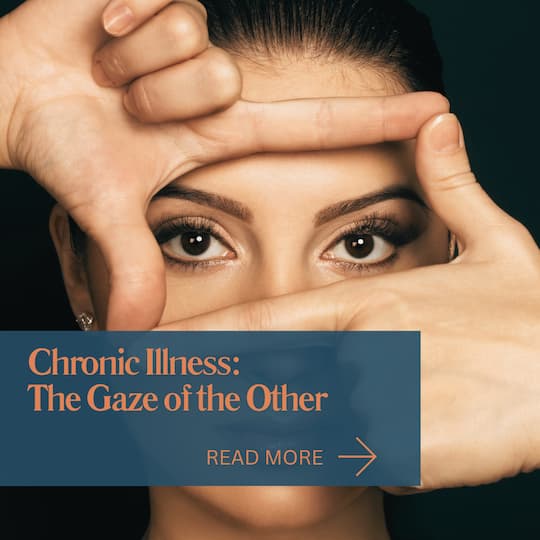
Not every part of our chronic illnesses are invisible. Even with invisible disabilities sometimes they have visible aspects to them. Sometimes with invisible disabilities the visible aspects do not happen all the time- so they can be difficult to deal with people’s attention to them and how to cope with the stares, the questions and the focus. The gaze of the Other. And the judgements that come with it.
What this can cause is
- Shame
- Embarrassment
- Frustration
- Guilt
I found this more so when I was young and profoundly when my disability was dominantly invisible. And these symptoms would crop up and subside, crop up and subside.
It is what it is most of the time. Until someone pays a little too much attention which made ME pay attention. And I didn’t like that. Made me feel uncomfortable in various ways when I shouldn’t have been.
Some of the things I have dealt with have been:
Keep in mind we all have different illnesses so everyone is different. These are just examples and how I coped with them.
Hand tremor
My hand tremor was likely one of the first early indications of MS. It comes and it goes. It may even be from FM. I would have problems at work with it. I have notoriously horrible handwriting and printing as is, and you add in a tremor and it is basically illegible to everyone aside from me. I called it my encrypted writing code.
In a busy work environment where you need to work at a fast pace, some things needed to be written instead of on the computer. And I needed to write them incredibly slow. Or it would become too messy to understand. That was one way to deal with the situation, whether people liked it or not. Unfortunately for me, they liked written forms over computer printed ones- which obviously I preferred. Because the best way for me to cope with writing is to do everything on the compter.
Out and about I often notice stares when signing or picking up things. I can’t do anything about these transactions. Nothing at all. I just have to ignore it. A tremor can be any number of things including nerves.
Vertigo
I have vestibular migraine and PPPD. When my vestibular disorder started to give me problems to a mild and moderate degree I started to have balance issues. When it was severe it was a functionality issue overall. But the lesser degree it was a work issue and balance issues.
I would be standing in a line in the morning somewhere and weaving a bit. Because I couldn’t stand still. Not unless I held onto something. But at times there was nothing to steady me. I knew people stared and I didn’t like it.
One day I got a remark behind me, that I distinctly heard, suggesting I was drunk- in the early morning and from then, I decided I needed a cane to steady myself. People see that, they still look, but they know it means something.
Drop foot
Drop foot causes me the most mobility problems. It kicks in in the heat of the day so I cannot walk much during that time. And it kicks in after a good 15 to 20 minutes of walking. People notice it pretty immediately. Whether I use my cane or not. It is obvious there is something wrong.
A lesson I learned recently is that I need my cane all the time. I went for a walk, early, as that is the best time of the day for me to make any real distance. I didn’t have my cane on me. The drop foot kicked in anyway. It just does some days. The ground was uneven. I had some balance and dizziness issues already. Add in the drop foot hitching on a lip in the sidewalk and I took air, hitting the ground hard. Landing on my knee, elbows and chin. Bruised my knee so severely that days later the bruise is still there down to the ankle now, pain is still there and makes walking even more problematic.
Someone stopped to ask if I was okay. I said I was. I wasn’t. I was embarrassed, stunned. And had a little trouble getting back up again. That is the problem with a fall and my drop foot. Sometimes my legs are weak too. And getting up can be problematic at best.
The Cane
Without my cane, the gaze of the Other can hold a massive amount of judgements. And you may never know what those judgements are. Like I heard that I was drunk that one time. And maybe when I took that fall someone assumed that as well. I can’t control what people think. Or how they behave.
Without a mobility aid I may look fine. I may in fact not look fine at all. It is hard to say. I don’t always walk well for sure. Even without the drop foot. When we look fine and random symptoms kick in we can’t control the minds of others. Like wearing our sunglasses for a migraine. I can’t help wanting to control the light sensitivity of a full blown migraine. But there are times when it doesn’t seem that bright out to others. It is to me. And indoors especially or in certain circumstances people think it is impolite to wear them- or at least that is the feedback I have gotten from time to time. Is it their place to say that. Not really, no. But again, I can’t control their beliefs. And they can’t know my reality.
When I use the cane, as I definitely always should now due to a few falls I have now taken… the judgements are all about my ability and functionality. Doors are opened for me. People do not look at me strangely if I use my disability parking pass. That sort of thing. It becomes a symbol for disability and ‘something wrong’. Now my disability is more present in the world due to my cane. And the gaze of the Other holds different sorts of ideas and beliefs about who I am. Some of which are equally unpleasant.
We can only be in the world as we are. We live in the bodies we have. The gaze of the Other is never something we will have any control over when it comes to these things. Stigma and discrimination can very well be the result of these visual cues. As they often are. But how we present ourselves to the world and are in the world is constantly being judged by others and whatever preconceived notions they have. We can’t be any different than who we are. I can’t control how my body is in the world. And I also don’t change who I am in the world for others.
I used to be bothered by these remarks and insinuations a lot more than I am now. But I still can be. Knowing my mobility has changed substantially and I will always get stares means I have adjusted to just being who I am. As I am with all other aspects of who I am. With my blue hair, t-shirts, hoodies and jeans. It is different for me as I adjusted from having a very invisible disability to a somewhat visible one. That visibility changes the stares for sure.
And now I must use my cane, and with that comes a lot of difference. And I am in the disability box. Which comes with a whole host of stigma.
Seen vs unseen. Stigma is there regardless.

 Chronically Nikki
Leave a comment