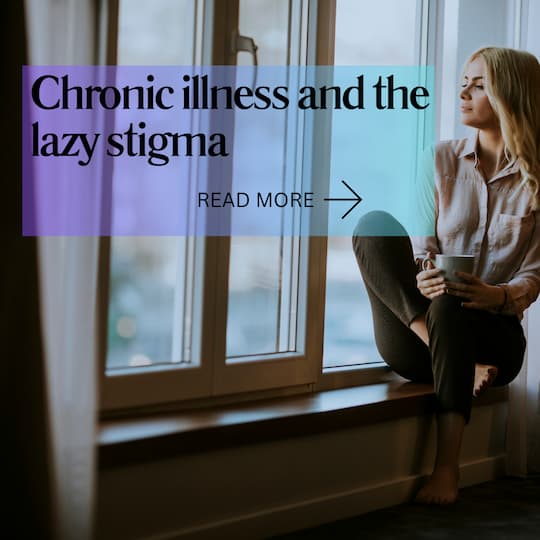
The stigma that people with chronic illnesses and chronic pain are ‘just lazy’ or are at times ‘lazy’ is pervasive. And difficult to dismiss. We, ourselves, are consumed with the guilt of what we can no longer do or not do as well or not do enough of. When confronted with this stigma it eats away at our self-worth. And we will eventually take this stigma into ourselves and self-stigmatize our own actions. Resting then becomes an act of betrayal.
One issue is symptoms mislabeled and misinterpreted as features people would call lazy.
- Fatigue– We need to rest with fatigue and fatigue management. We may need to sit down. We may need to pace our activities. We may not be able to do certain activities. We may need to nap. So many things can be impacted by fatigue alone.
- Chronic pain– Pain itself is exhausting. Pain requires that we pace throughout the day. Whether we are having a low pain day or a high pain day we must pace- or suffer the consequences of a cycle of pain roller-coaster ride of where pain exceeds our limits and we crash for days (often perceived as lazy).
- Difficulty concentrating/memory– which can cause brain fog and affect our overall productivity levels.
- Insomnia– Lack of sleep is common in many chronic conditions and with chronic pain. Lack of sleep can lead to sleep deprivation, erratic and irregular sleep cycles. This can lead to daytime drowsiness, low productivity and day time periods of rest.
None of these affect our desire or motivation, although they can. But they certainly affect our ability to perform and therefore can be perceived as laziness.
Behind closed doors
One issue is that people do not in fact see the person with a chronic illness or chronic pain at their worst but rather at their best. So when they see us faulter or stagger and dwindle in energy or reserves- this is perceived as a fault in our very nature or personality. Because most of our intolerable and non-functional pain and symptoms are hidden away behind closed doors.
Another problem is that people who do see us behind closed doors see us rest, pace, nap and perceive those things as laziness when those things are necessary in order to function at the level at which we do.
Behind the mask
We actually mask a great deal of our pain and symptoms behind a facade of well-being. A smile. A laugh. A joke. A stoic facade. What have you. People cannot see the pain and symptoms under the skin. We do this to function in society and work and be with people.
This has the unintentional consequence of behaviours that are seen being perceived as some sort of innate weakness. Resting, for example. Pacing, for another example. Flex work. Not working overtime. Timing breaks for certain times. Not going to events that are too far away, too noisy, too long in duration.
Worth and productivity
Our worth is not intrinsically tied to our productivity. What we do for a living is not tired to our worth as a person. We are not lazy because we are on disability. We are not lazy because we need to rest more, pace more or nap more. Or conserve our energy more.
Do more
The drive to do more, in my case, from internalized stigma can be intense. I can have immense fatigue and still push myself to do more than I should. To exceed my limits because of this intense guilt. This sense I am not doing a sufficient amount in the day. Just the day. Not enough. And then when I do exceed my limits I crash hard. And I feel guilty for That as well.
Things that people say, intentionally or otherwise can sting
- It must be nice to sleep in- when in fact we have barely slept at all
- Must be nice to not work- when in fact we suffer with little to no income and tremendous guilt.
- It must feel like you’re on vacation- And it rather doesn’t
- I wish I could just have a nap- implying we do not need the rest and they are too busy to ever take the time for one if they in fact needed one
I used to get a lot of stigma for a lot of people. A lot of it implied I was calling in sick from migraine attacks to get time off. Because I simply did not want to work. That I was simply malingering. Faking. Lazy as effing eff.
We encounter this ‘lazy’ stigma in many places but work is certainly one of them. They have no idea how much I used to beat myself up over missing work. They wouldn’t have needed the comments if they did. I did it to myself quite well, thank you. I felt useless, worthless and nonproductive and nonfunctional. I felt like I was failing, as a person. Every person that says something like that drives it home that I should have been ashamed. I was a grown ass woman and I should just work. Just push through the pain harder.
Many times remarks to me were expected. They didn’t see me at my worst. And at my trying to get through the day I masked my pain. They were clueless to my existence. But what they did know is that someone had to cover my shift. And that is problematic. If someone didn’t cover they were short. If they were short customers are angry. If someone there was covering my shift, they were not doing their job. And this made them angry. And that anger was projected at me. And it came out in the form of stigma. And if I was there but not mentally there that was likewise a problem. Because I was basically a problem.
I tended to absorb it all like a sponge and not respond. Which isn’t good. I think of that office years ago and if I had just stood up and stopped the stigma by explaining the discrimination that was going on to her, to her boss and to HR. Well, things would have been different. But even with one person, or more likely more, I just took it. I wonder what I would say if I had been more assertive.
That was then. This is now. Now I am on disability. And people will call me lazy for entirely different reasons. Entirely different scenarios.
It is a hurtful one. Mostly I believe it is hurtful because we strive so much, but get nowhere for our efforts. And because we suffer the consequences of any effort, but no one sees the consequences. Not to mention we feel intense guilt for not being as we once were. Not able to do the things we want to be able to do. We know our limitations and at times it grates on us we cannot meet the expectations of ourselves, society and others. We suffer a great deal when we push ourselves beyond our limits, trying to succeed. Such horrible pain. And it only makes things significantly worse.
This stigma eats at us immensely. Even though logically we know we have to pace. We know we need to rest. We even know having a nap is healthy. And sleep is necessary to our physical, mental and emotional well-being. We know productivity takes on new meaning when we cannot work and is not attached to our value as a person. And it varies from day to day.

 Chronically Nikki
Why am I getting this email?Who the heck are you?And how do I unsubscribe or whatever , like , have no idea why this is in my box
LikeLike
I have no idea. I was the brainless blogger but I renamed myself. Perhaps that is how you know me. Otherwise it is some sort of glitch. I assume you unsubscribe the usual way- at the bottom of the email there should be a small print unsubscribe button?
LikeLike