Setbacks when it comes to chronic illness seem to just be inevitable. Sometimes they are not setbacks at all but our new state of the normal. And sometimes they are short setbacks. Other times they are substantial setbacks.
A setback with our health can be caused by many things. A medication change, a stressor or a downturn in our health.
What to do with setbacks in our health
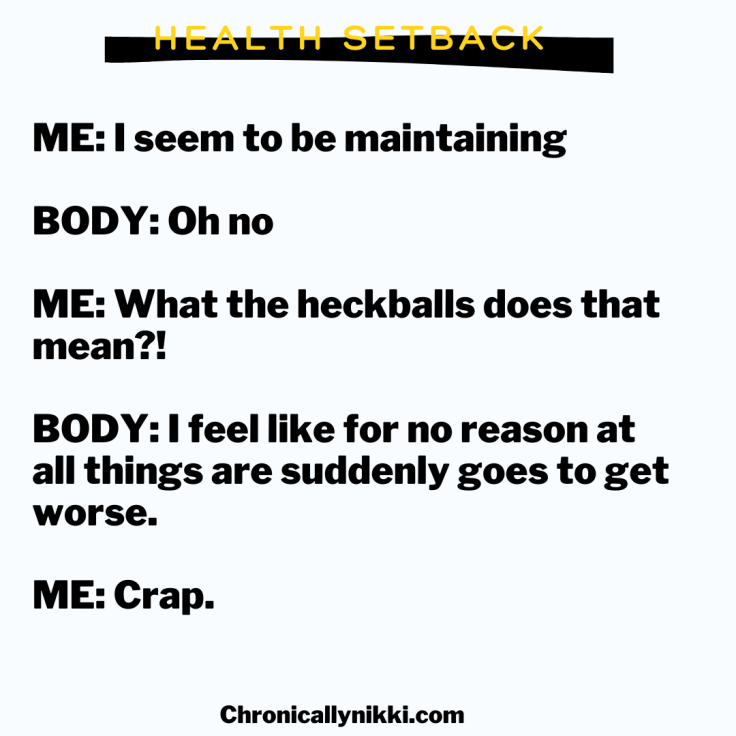
- Accept and Acknowledge: It’s important to recognize and accept the reality of the setback. Denial or frustration can make things harder. Allow yourself to feel your emotions without judgment. Feel those feels. Don’t judge them.
- Not Internalize the Setback– no self-blame, self-hate or sense of personal failure for something that is often out of our control no matter how much we exercised or how many vitamins we took. Sometimes our health takes a downturn.
- Set Realistic Goals and Activities: Adjust your goals to fit your current abilities. Smaller, achievable goals can help you maintain a sense of progress and control. This requires an assessment of your current state and how you may need to alter goals and day to day activities.
- Self Care and Take care of Mental and Emotional Well-Being– when we experience a health setback which sometimes is a new state of being we have to adjust our coping to that. And in that adjustment period it can be extremely emotionally and mentally taxing. I am in this state now and I know, as I have known in the past, taking care of my mental and emotional health during these times is extremely important. So self-care is very important. Rest is very important.
- I remind myself of the vital importance of pacing so I don’t find myself in denial and push too hard. Pace on the bad days. Pace on the good days. Avoid the boom and bust cycle.
- Seek Support: Talk to friends, family, or support groups. Sometimes just sharing what you’re going through can provide relief and understanding.
- Work with Your Healthcare Team: Keep open communication with your doctors or therapists. They can help adjust your treatment plan or provide guidance tailored to your current situation.
- Practice Stress Management: Techniques like mindfulness, meditation, or deep breathing exercises can help manage stress, which might improve your overall well-being. Whatever works for you.
- Focus on What You Can Control: While you might not be able to control the illness itself, you can control how you respond to it. Focusing on the things we can control is empowering. Focusing on what we cannot control can be extremely frustrating.
- Take things slow as you adjust your current health needs Remember that setbacks are a normal part of dealing with chronic illness. Treat yourself with self-compassion and patience.
Overcoming goal setbacks
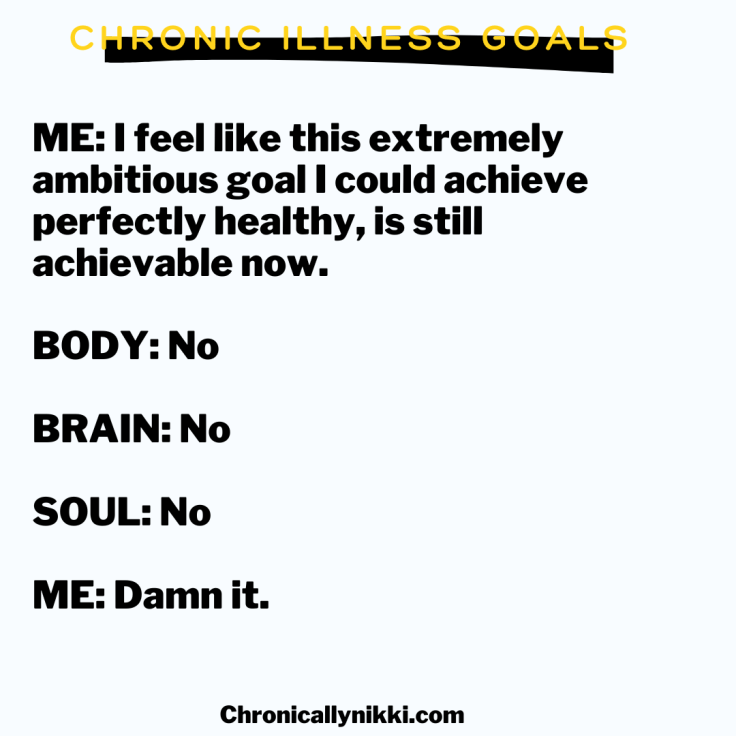
This is a weird piece of research that I wonder if it might be helpful. Or not, given our context. But think of a setback of a health goals. Or any particular goal you have.
There has been some research to suggest to overcome setbacks it helps if instead of looking at the Internal factors (within us) to look at the external factors involved (Outside of us). As we often ignore any external factors of our setbacks.
The ‘setback effect’ which can lead to more failures is when we solely focus on more stable internal factors such as our nature and personality. Whereas to prevent the setback effect we have to shift our mindset to pay attention to external factors.
Research shows people are more likely to experience subsequent failures after an initial self-control failure. This is called the setback effect. The setback effect commonly occurs when a person attributes a failure to internal factors beyond their control (e.g., genetics).
But if we look at the failure as having some external influences than we are more likely to refocus on our goal, remain confident in our abilities, and then continue on our path to future successes
This setback effect is more likely when a person believes the negative result was caused by stable, internal factors (e.g., genetics, personality traits, lack of intelligence, low ability) than unstable, external causes (e.g., bad luck). Why? Perhaps because these internal attributions result in reduced self-confidence and self-efficacy.
It suggests when we have a setback to consider the external influences involved: friends or people around us, TV commercials or social media, medications, doctors, events, things we heard, things people said- things that impacted us in some way. I think with chronic illnesses we are particularly good at internalizing our setbacks when it comes to goals of any sort. Without acknowledging how very hard it is to set goals in the first place. So acknowledging all the factors, including the health ones and the external ones can give us a realistic view of that goal and its setback. As well as a realistic view of how to set the goal in the future.
Personally,
I internalize a lot. I often blame myself for any goal setback. My motivation rather than my immense fatigue. My lack of ambition rather than the fact the pain has been a bit Much. And sometimes my goal setting, at least in the past lacked the ability to account for my health effectively. I think now when I set a goal I am more realistic with my goals and breaking them down.
Health setbacks are a lot harder to handle. I am in the midst of one. And the fatigue alone is difficult to deal with. And with that it is really hard to have any get up and go. I have to have a lot of self-compassion for the fact I am just not able to do a lot at this particular time while I adjust to things. And no internalize it. Definitely trying to focus on my mental and physical well-being as best I can. And at these times, I find focusing on what I can do one of the most important factors.
 Chronically Nikki
I often think of my chronic pain as ‘tidal’ it comes in and it goes out – I enjoy the good days when they arrive, and understand that they might not last, no matter how hard I’m trying to heal… You sound like you’re very self-aware already, so ignore me – except to know that I’m sending a gentle hug your way, Linda xx
LikeLiked by 1 person
I agree, it is very much like that. I used to hate that flux- the unpredictable nature of it but now, I just go with the flow of it knowing it is out of my control in some aspects- and I just have to cope with it as they come
LikeLiked by 1 person
That’s all you can do – may today be one of the good days. L xx
LikeLiked by 1 person