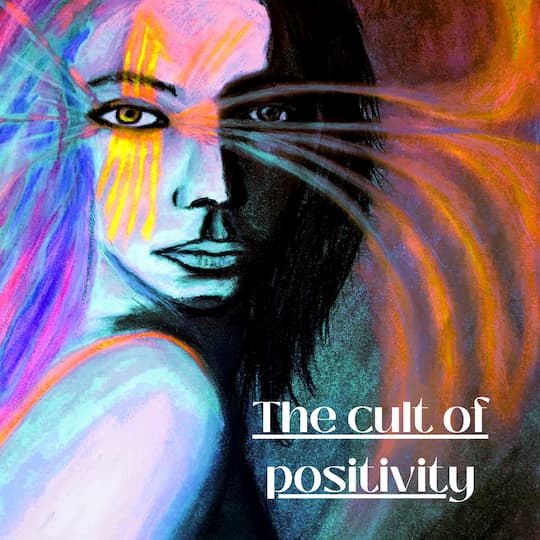
There is nothing wrong with being positive or working of thinking positive. We can be caught in a net of negative thinking and need to adjust ourselves to more realistic thinking. And there is some research to back that. And that is definitely not what I am talking about. That is a good thing. I did CBT for depression and pain and it was quite beneficial for my mental well-being. Just tweaking the brain ball.
This isn’t about being an optimistic person. If you are… do your thing, man. Keep on keeping on.
It isn’t about having hope or being happy or being in general positive about your life. I mean, I maintain my mood via a lot of ways to manage my depression and pain. Gratitude journal and many other things. I work through overtly negative catastrophizing thoughts (CBT). And hope, well, a little of that goes a long way. This is about the Movement of Positivity. The Toxic Movement really. The Cult of Positivity. And that is different. Very different.
The cult of positivity is more of a cultural plague these days
I call it the cult of positivity because it is basically toxic positivity that has influenced 800 self-help books into convincing people they call will themselves into happily ever after. Like Happy is a state of mind you can exist in all the time. Like it is an end goal. A lot of self-help books are mindless brain fluff. But they sell well so I know a lot of people disagree with that. I assume not all of them are. But some of the ones I tried to read definitely were. A whole lot of nothing in them.
It is almost a pervasive belief system that has been growing for some time. And in a way, it promotes stigma in some cases for people with chronic illnesses like mental illness. In a way, it does a disservice to everyone else who reads it or believes it because they are fooling themselves into thinking they are not fully developed emotional beings… that have to deal with and have ‘negative’ emotions. Not deny them. Not run from them. Not shove them down and repress them. Not force yourself to be positive and pretend they don’t exist. Actually feel them and deal with them like the fully developed emotional being you are.
And in this cultural plague, there is no room for mental illness. Because you should poof it out with just ‘thinking positive thoughts’. That literally we have control over and choose our state of mind.
Me: I am so depressed
Them: Oh, have you tried thinking like happy thoughts? Like throwing happy thoughts like out into the universe so like happy things like happen to you? Like forcing happy thoughts into your head all the time so like the depression just stops?
Me: Oh! Damn! That totally cured my depression! Gee. I wish I had thought of that before! *intense sarcasm’
They ignore the neurological reasons for mental illness. Ignore the habitual thought patterns. Even the situations and health issues that may underlay the mental illness. Ignore the trauma that may be underlying it. Nope. None of that matters if you have the right Mindset. Just Will yourself into the right Headspace and cure yourself. Bam. Cured. And totally your fault if you’re not.
Not sustainable
We cannot live up to the cult of positivity. If we try doing this will ourselves into a positive mindset to cure ourselves we fail. And we blame ourselves. And we feel guilty and ashamed and weak. In other words, it backfires and we feel even worse for not being able to live up to an impossible standard.
The idea that you can be happy if you simply choose to be has been integrated into America’s military, classrooms and workplaces to improve coping skills, performance and mental health. Newsweek
Shame
Shame is not cool, and that is what the Cult of Positivity does. But acknowledging our emotions, all of them, is very healthy and that is what we should be doing for our overall well-being
But as the movement’s popularity grew, it started being used to shame people with depression, anxiety or even occasional negative feelings. The August and October issues of Motivation and Emotion, the official journal of the Society for the Study of Motivation, have studies that prove the shaming is real. The study from the August issue, conducted by Karin Coifman and colleagues, concluded that when people acknowledge and address negative emotions toward their relationships or chronic illnesses, it helps them adjust their behavior and have more appropriate responses. Those negative emotions, in turn, benefit their overall psychological health. The October study, conducted by Elizabeth Kneeland and colleagues, concluded that people who think emotions are easily influenced and changeable are more likely to blame themselves for the negative emotions they feel than people who think emotions are fixed and out of their control. Newsweek
I hate to say it, but we are emotional animals that have a full range of emotions. In no way, should we feel guilty for having the less appealing emotions… they are just as real and just as fundamental and just as psychologically important as every other emotion.
Research bears that out. A 2012 study undertaken at the University of Queensland and published in the journal Emotion found that when people think others expect them to not feel negative emotions, they end up feeling more negative emotions. A 2009 study published in Psychological Science found that forcing people to use positive statements such as “I’m a lovable person” can make some feel more insecure. Further, New York University psychology professor Gabriele Oettingen and her colleagues have found that visualizing a successful outcome, under certain conditions, can make people less likely to achieve it.
Researchers have also found that people in a negative mood produce better quality and more persuasive arguments than people in a positive mood, and that negative moods can improve memory. Newsweek
We can use positivity to as a form of denial… of things going very, very wrong as a way of avoiding dealing with them. In fact, with chronic illness, we have to deal with a lot of problems all the time (financial instability, work problems, insurance companies, disability… the list goes on… we can not bury our heads in the sand and avoid it)
Psychiatrist Dr. Mark Banschick argues that positive thinking can become a way of avoiding necessary action. People might say everything is fine even when it isn’t and avoid fixing the problems in their lives. Beth Azar wrote in an article published by the American Psychological Association that there is a widespread and overblown confidence in the power of the positive, including the misperception that people can stave off illness with optimism. Newsweek
Dealing with our emotional landscape
Dealing with our emotional landscape is healthy. All our negative emotions are part of that landscape. We just have to learn how to emotionally regulate. We have to learn how to cope and handle our negative emotions. How to feel them. How to let them flow through us. How to react to them.
Emotions are a constant flow. We move from one to another to another. Supressing ones we feel we should not be having is what is unhealthy. Not allowing yourself to process your emotions is what makes them become a problem. You are not just your positive emotions and you can’t force yourself to be. There is no riding the positive train to happiness.
We are emotional meat sticks, really. All the emotions are a part of our reality. Might as well get used to that. And learn to feel comfortable with them.
reprint from brainlessblogger.net
 Chronically Nikki