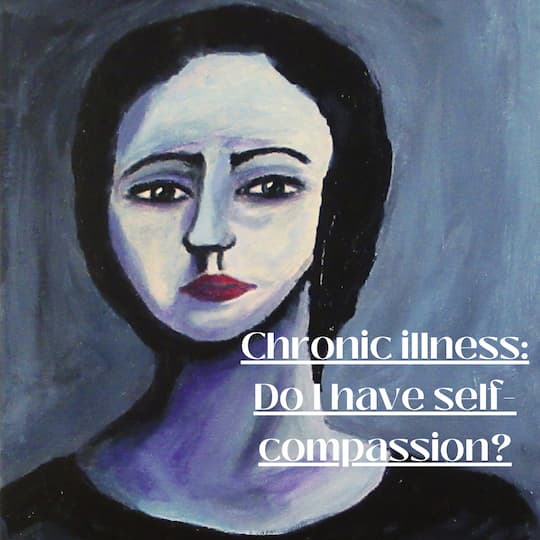
When we’re struggling with illness our self-esteem and self-worth can plummet. We may see ourselves as stagnant, irritable, unlovable and stuck. Research shows that maintaining positive feelings about ourselves during illness flares can improve both physical and mental well-being. Achieving this can be a struggle.
Kristin Neff is a leading researcher on self-compassion according to Psychology Today. Neff has written, “People feel compassion for themselves, because all human beings deserve compassion and understanding, not because they possess some particular set of traits.”
Self-compassion involves three main elements:
- Self-kindness vs. self-judgment.
- Mindfulness vs. over-identification with thoughts.
- Common humanity vs. isolation.
One wonders if we can love ourselves like we should with chronic pain and chronic illness? When we feel the burden of limitations, financial instability and a sense of failure.
When we are coping well and our pain and illness feels manageable maybe then we feel better about ourselves. But what about when we struggle? What about when we try to set goals and fail? What about when we feel like a burden to our families? Or a failure as a person? Then do we love ourselves?
Some self-compassion during our really difficult times is something we have to try and engage in but it can be difficult. Maybe because we spend so much time being brutal on ourselves and judgmental it takes some time to break that pattern.
Self-Kindness and Non-Judgment
We have to really watch our self-talk on those bad days, or long bad stretches. Because that can stick for a long time. Our brain really, really listens to that until those thoughts just pop up and then become a habit. I have learned this lesson through depression when my self-talk was Brutal. I mean, man, talk about being one’s worst critic and never giving myself any slack.
Negative self-talk happens to everyone. We all have a part of ourselves that seems to undermine our talents, achievements, skills… our overly critical selves. I think it gets worse with chronic illness because from the get-go we try to Be Who We Were. Like nothing changed. But it did and when we have to realize that it doesn’t align well with our sense of self and the core values of who we are… and instead of adjusting that, we feel really cruddy and punish ourselves for not being the Perfect US that we cannot ever be. And every time we fail to achieve a standard we feel like we Would have we feed that negative self-talk. Give or take a year, five, ten… and those thoughts can be pretty embedded in us. And worse. Just nasty.
When I started cognitive behavioral therapy for chronic pain and depression I had a mood journal where I wrote down my self-talk and then how that wasn’t accurate Really, and how to replace it with something more kind to myself. Writing it down at first helps you work things out and helps you become more and more aware of your self-talk. You can also try writing a letter to yourself… but say you pretend you are your own best friend, then what would you say to yourself? What would someone who loves you say? Outside of your perspective, what would someone who cares for you say?
The best thing to do when I find myself being overly critical of myself is to:
- Shut down that line of thought. Literally, tell myself to be quiet and turn to other thoughts. Or ‘this will pass’
- Distract my mind with art, reading, writing… even journal writing
- Think rationally about that prickly little thought and analyze it. See how brutal I am being towards myself. Remind myself I would never be that way to another person and have some empathy for what I am going through.
- Remind myself rest and recovery are necessary to my well-being and NOT A FLAW.
What if we try something different and treat ourselves with acceptance? Instead of chastising ourselves for everything we’ve done wrong, we could try to understand it. “I do tend to overdo things in a way that exacerbates my illness. Sometimes I just so want to be ‘normal’ that I forget my limitations. I’ll try to take better care of myself in the future, but I can feel empathy for the part of myself that wants to do everything.” “I feel so blah when I’m sick, and that’s okay. I can’t expect myself to be energetic and cheerful when I’m hurting.” Psychology Today
Mindfulness
I like to be aware of my emotions, acknowledge them, but not ruminate on them… not dig into them and dive deep into them. If I am feeling sad because I cannot function that day… I accept that I am, I know it will pass, I accept it is a normal feeling to have and just let it flow through me.
We are permitted to have emotions. Not every emotion we feel is going to be sunshine and rainbows. It is how we learn how to regulate and cope with negative emotions that is important not suppressing that we ever feel them in the first place. We experience a lot of difficult emotions with chronic illness and pain. We have to learn so many ways to cope with that.
I also do some relaxation breathing to relax myself. Or some meditations, of various sorts to relax my body and mind. I have a mantra of ‘this too shall pass’ and it works for me simply because emotions are fluid and fleeting and I know they will pass.
Self-compassion is cultivated by attention to mindfulness, defined as taking a balanced view of one’s negative emotional states rather than becoming embroiled with them. Importantly, mindfulness does not mean ignoring or denying our negative feelings. On the contrary, it’s important that we pay attention to them. What mindfulness asks of us is that we not get stuck in those feelings. When sadness overtakes us, for example, we need to feel the ache in our chest and the darkness in our mind. We say, “Here is sadness. It is a feeling that is part of being human and eventually it will pass.” We try not to chastise ourselves for feeling sad or cling to the false belief that sadness will last forever. We simply sit with it and breathe. Psychology Today
I don’t think self-compassion is important for no reason. It has real value in helping us cope and have acceptance for our chronic illness.
We could all benefit from some self-compassion for sure. It is a tricky one though. I have to say it wasn’t that long ago when I literally had no self-compassion for myself. It took seeing a psychologist for pain and depression for me to slowly start to. And then it slowly, inch by inch, day by day, year by year, developed from there. But some days… not as much as others. It is a tricky pickle this one and I have to constantly remind myself of it. And some years I just don’t do well with this one.
So I do have self-compassion now. Definitely on my bad days. It is just sometimes I have to work at it. I spent decades being really harsh on myself and it takes time to break that cycle. And with setbacks it can be twice as hard, I find. Maybe I internally judge myself for setbacks as well. Do you have self-compassion?
reprint from brainlessblogger.net
Resources:
Self compassion in chronic illness
The Benefits of Self-compassion
 Chronically Nikki